Invisalign or braces: which should you choose?
Clear aligners such as Invisalign are discreet and removable, but you need to wear them for around 22 hours a day. Braces are fixed and give more control over some complex movements. At our clinic in Les Corts, Barcelona, we assess your bite and recommend the option that suits you. Every case needs an assessment, and neither suits everyone.
Two ways to move teeth
Aligners and braces do the same job: they apply gentle, continuous pressure so that teeth gradually move through the bone. What differs is how that pressure is applied.
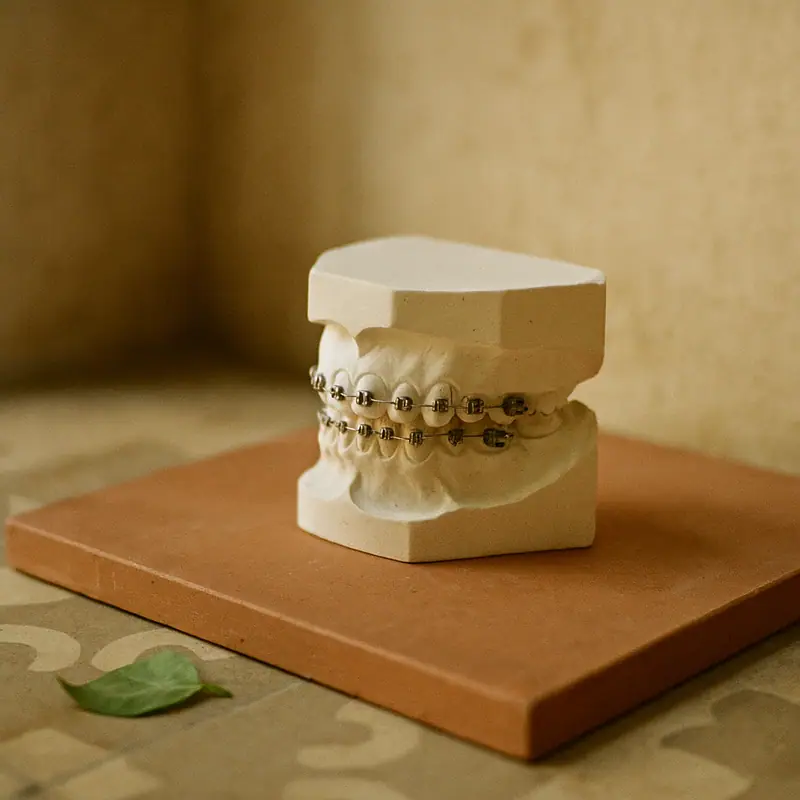
Braces are small brackets bonded to the teeth and joined by a metal wire, which the dentist changes or adjusts at each review. Aligners are clear plastic trays made to measure from a digital scan; each set moves the teeth a short distance and is swapped for the next one every one or two weeks, depending on the system.
Invisalign is the best-known aligner brand, but not the only one: other systems work in a similar way. What matters most isn't the brand so much as the planning and follow-up by your dentist.
Quick comparison
This table sums up the most common differences. These are general trends: your own case may not fit them exactly.
| Aspect | Clear aligners | Braces |
|---|---|---|
| Appearance | Almost invisible | Visible (ceramic ones are less noticeable) |
| Removable | Yes, for eating and brushing | No, they're fixed |
| Daily wear | 20 to 22 hours a day | Always in place |
| Cleaning | Easier | Needs more care and interdental brushes |
| Food | No restrictions (they come out) | Avoid hard and sticky foods |
| Complex cases | Good for many mild and moderate cases | More control for complex movements |
| Typical duration | 6 to 18 months | 12 to 24 months or more |
| Reviews | Roughly every 6 to 10 weeks | Roughly every 4 to 8 weeks |
| Approximate cost in Barcelona | €2,500 to €6,000 | €1,500 to €3,500 (metal) |
When aligners tend to work best
Aligners work very well for adults and teenagers with mild or moderate crowding, small gaps, or teeth that have moved back after previous orthodontic treatment. They're also a good option if you deal with the public at work and prefer something discreet.
Their weak point is commitment. An aligner that spends too long in its case doesn't move teeth, and treatment takes longer or doesn't achieve what was planned. If you know you'll struggle to wear them, it's best to say so from the start.
- Mild or moderate crowding
- Gaps between teeth
- Relapse after earlier orthodontic treatment
- Committed patients who value discretion
- People who play contact sports or wind instruments (aligners can be removed)
When braces tend to work best
Braces are still very useful for complex movements, such as rotating a tooth significantly, closing large gaps after extractions or correcting major bite problems. Because they're fixed, the result doesn't depend on the patient remembering to wear them.
For growing children and teenagers, an orthodontist may combine braces with other appliances to guide jaw development. That's why an orthodontic check around age 7 is recommended, even if treatment starts later.
- Severe crowding or heavily rotated teeth
- Significant crossbite, open bite or deep bite
- Cases involving extractions
- Children and teenagers who may not stick with a removable appliance
Cost: what you're really comparing
The ranges in the table are approximate and based on quotes published by clinics in Barcelona. The final price depends on complexity, number of aligners, type of bracket, reviews and retainers. When comparing, ask whether the quote includes the initial records, refinements (extra aligners if needed), reviews and retainers at the end.
For our own prices, please check our prices page. And if cost is a concern, ask about payment-plan options at your assessment.
What never changes: retainers and reviews
Whichever you choose, treatment doesn't end on the day your braces come off or you hand in your last aligner. Teeth tend to move throughout life, and retainers (fixed, removable or both) are what hold the result.
At our clinic in Les Corts we always start with a full assessment: we check your teeth, gums and bite, and tell you honestly which option makes most sense for you, even if it isn't the one you had in mind. The digital simulations we show are approximate, and results depend on each case.
Frequently asked questions
Is Invisalign faster than braces?
In simple cases it can be, but not always. Treatment time depends mainly on complexity and on how consistently aligners are worn. In complex cases, braces are often more predictable.
Can teenagers have Invisalign?
Yes, there are aligners designed for teenagers. The key is that they commit to wearing them for the recommended hours. If not, braces are usually the safer choice.
Which hurts more, braces or aligners?
Both cause some pressure for the first few days after each change or adjustment. Braces can rub the cheeks at first. Generally, both are very manageable.
How much do clear aligners cost in Barcelona?
Roughly between 2,500 and 6,000 euros, depending on complexity. For our prices, check our prices page and book an assessment.