Teeth whitening: myths and facts
Professional teeth whitening, using regulated products under a dentist's supervision, is considered safe for enamel; the most common side effect is temporary sensitivity. Baking soda and charcoal don't change the inner colour of the tooth. At our clinic in Les Corts, Barcelona, we always check your mouth before starting any whitening treatment.
How whitening really works
The colour of a tooth depends mainly on the dentine, the layer beneath the enamel. Over the years, coffee, tea, wine, tobacco and ageing itself darken that colour.
Whitening gels contain hydrogen peroxide or carbamide peroxide, which release oxygen and break down the molecules that cause discolouration. That's why whitening changes the tooth's inner colour, while a professional clean or a toothpaste only removes surface stains.
In the European Union, Directive 2011/84/EU states that products containing more than 0.1% and up to 6% hydrogen peroxide may only be supplied to dental practitioners, that the first use must be carried out or supervised by a dentist, and that they must not be used on anyone under 18.
Myths and facts at a glance
These are the beliefs we hear most often in the surgery, alongside what the available evidence says.
| Myth | Fact |
|---|---|
| Whitening ruins your enamel | With regulated products and professional supervision it's considered safe; temporary sensitivity is the usual side effect |
| Baking soda whitens teeth | It's abrasive: it can remove surface stains but doesn't change the inner colour, and overuse wears enamel |
| Charcoal is natural and safe | There's no solid evidence it whitens, and it can be abrasive |
| Whitening toothpastes give the same result | They help with surface stains but don't lighten the base colour like a peroxide gel |
| Results are permanent | Colour tends to darken over time depending on habits; it can be topped up |
| Fillings and crowns whiten too | No: they keep their colour and sometimes need replacing to match |
| The whiter, the better | Every tooth has a limit; we aim for a shade that looks natural on you |
Myth: "whitening damages your teeth"
This is the most common worry, and it's a fair one. The available studies suggest that supervised whitening with regulated concentrations doesn't cause meaningful damage to enamel. The most common side effect is tooth sensitivity, which is usually mild and fades a few days after treatment ends. The gums can also become irritated if gel touches them, which is avoided with well-fitting trays or by protecting the gums in the clinic.
Problems mostly arise with products of uncertain origin bought online, concentrations outside the regulations, or repeated treatments without supervision. That's why a dentist should check your mouth first: with open cavities or inflamed gums, whitening can hurt and isn't the right moment.
Myth: "baking soda or charcoal does the same job"
Baking soda and charcoal work by abrasion: they scrub the surface and can remove some external stains, which makes teeth look a little brighter. But they don't reach the tooth's inner colour. Used often and with force, they can wear down enamel and expose the dentine underneath, which is more yellow. In other words, in the long run they can have the opposite effect.
Over-the-counter strips and kits that comply with EU rules contain very low concentrations, so their effect is usually limited. They aren't dangerous when used as the manufacturer directs, but it's worth keeping expectations realistic.
Professional options and approximate prices
There are three main types of professional whitening. The prices below are approximate market ranges in Barcelona, based on quotes published by clinics; they aren't this clinic's prices. For ours, please check our prices page.
- In-clinic: one or two sessions with a stronger gel and gum protection. Roughly €250 to €600
- At home with custom trays: a lower-strength gel over 2 to 3 weeks, supervised by your dentist. Roughly €200 to €450
- Combined: one in-clinic session followed by home whitening. Roughly €350 to €700
How to make the results last
For the first 48 hours, teeth are more porous and pick up pigments more easily: avoid coffee, tea, red wine, cola and strongly coloured sauces. After that, cutting down on tobacco, rinsing with water after coffee and keeping up your professional cleans all help the colour last longer. If you have trays, you can do small top-ups at home when we advise.
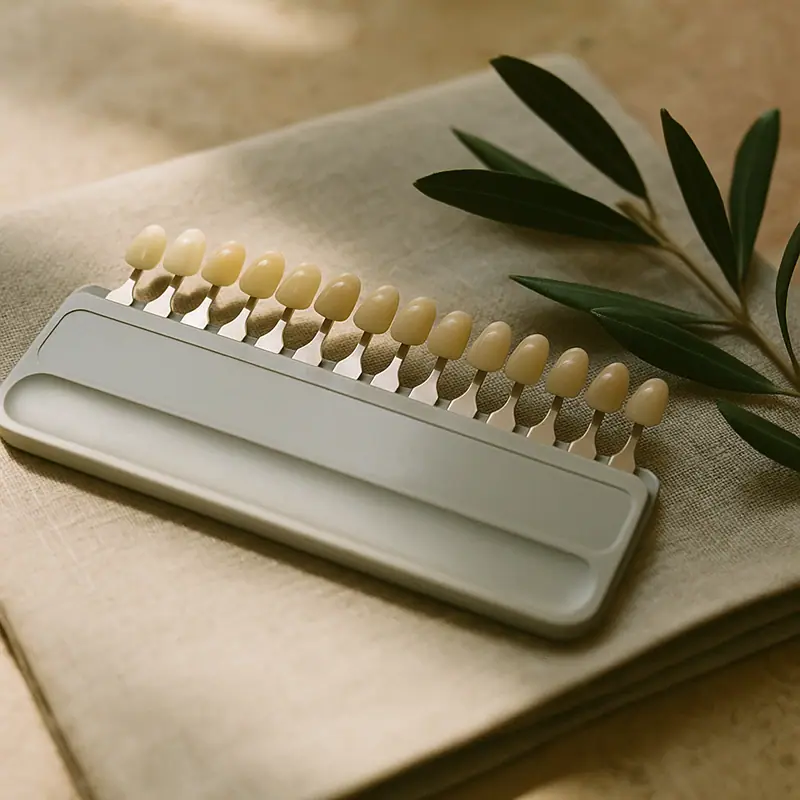
At our clinic in Les Corts, Barcelona, we always start with a check-up, record your starting shade and explain what's realistic for you. The before-and-after images we show are illustrative: every mouth responds differently.
Frequently asked questions
Is teeth whitening safe?
With regulated products and a dentist's supervision, it's considered a safe treatment. The most common side effect is temporary sensitivity. It isn't suitable for under-18s or during pregnancy.
How long does whitening last?
It depends on your habits. With little coffee, tea or tobacco and regular cleans, results can last a good while and can be topped up. There's no guaranteed timeframe.
Does baking soda whiten teeth?
It doesn't change the tooth's inner colour. It can remove some surface stains, but it's abrasive and frequent use can wear enamel.
Can I whiten my teeth if I have veneers or fillings?
Yes, but veneers and fillings won't change colour. Some may need replacing afterwards to match. We'll explain this at your assessment.